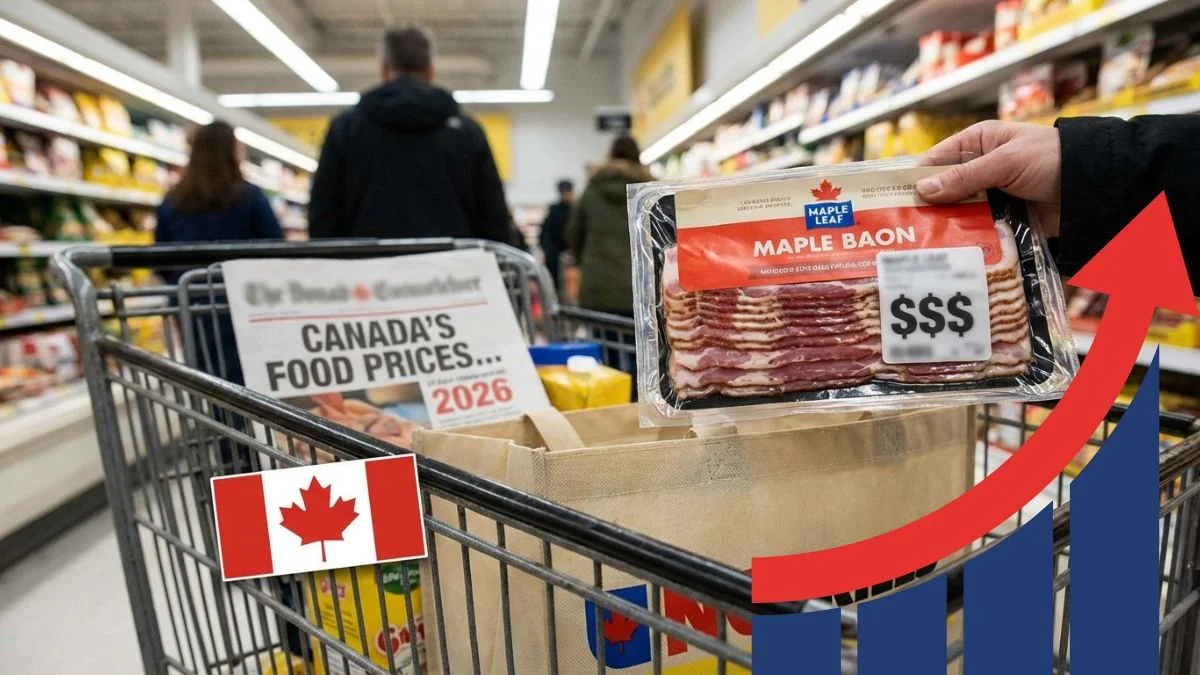
The latest economic data for early 2026 confirms that Canadian households are facing a sharp resurgence in food costs. According to the most recent Consumer Price Index (CPI) report from Statistics Canada, food inflation reached 7.3% in January 2026.
This figure places Canada at the top of the G7 for food price acceleration, significantly outpacing the overall national inflation rate of 2.3%.
The Impact of the Base-Year Effect and Policy Changes
A primary driver behind the 7.3% spike is a “base-year effect” resulting from federal tax policies implemented a year ago. Between mid-December 2024 and mid-February 2025, the Canadian government enacted a temporary GST/HST holiday on various grocery items and restaurant meals.
This measure artificially lowered food prices during that period in 2025. Because current inflation is calculated on a year-over-year basis, the return to standard taxation levels in 2026 has created a mathematical jump in the reported rate.
Experts from the Canada Food Price Report 2026 suggest that even without this distortion, food inflation would still remain elevated at approximately 6.3%.
Key Categories Driving Cost Increases
While prices are rising across the board, certain categories are experiencing more volatility than others. The following sectors are currently leading the upward trend:
- Meat and Beef: Beef prices have risen by as much as 17% year-over-year. This is attributed to shrinking cattle herds following nearly a decade of drought in major producing regions and higher costs for animal feed.
- Imported Goods: A weaker Canadian dollar and ongoing trade disputes have driven up the cost of imported items. Coffee and confectionery saw increases of 31% and 14%, respectively.
- Restaurants: Dining out has become significantly more expensive, with a 12.3% increase reported in the restaurant sector, partly due to the expiration of the previous year’s tax breaks and rising labor costs.
Regional Disparities and Household Expenditure
The impact of food inflation is not uniform across the country. Data indicates that Quebec, Alberta, Nova Scotia, and Prince Edward Island are expected to see price increases that exceed the national average throughout 2026. Conversely, British Columbia and Manitoba may see a slight deceleration compared to their 2025 peaks.
For the average Canadian family of four, total annual food expenditure is projected to reach $17,571.79 in 2026. This represents a nearly $1,000 increase compared to the previous year. Researchers note that food prices are now 27% higher than they were five years ago, straining the budgets of the approximately 25% of Canadian households currently considered food insecure.
Government Intervention and the Groceries Benefit
In response to these affordability pressures, the federal government has passed Bill C-19, also known as the Canada Groceries and Essentials Benefit Act. This legislation aims to provide financial relief to approximately 12 million low- and modest-income Canadians.
Starting in the spring of 2026, eligible citizens will receive a one-time top-up payment. This will be followed by a permanent 25% increase to the recurring benefit starting in July 2026. Under this plan, a family of four could receive up to $1,890 in total support this year to help offset the rising cost of living.
Frequently Asked Questions
What is the current food inflation rate in Canada for 2026?
As of early 2026, food inflation in Canada has reached 7.3%, according to Statistics Canada data.
Why did food prices jump so high in January 2026?
The increase is largely due to the expiration of the 2025 GST/HST holiday, high meat prices, and the rising cost of imported goods.
How much more will the average family spend on food in 2026?
A family of four is expected to spend up to $17,571.79 on food this year, an increase of approximately $994 from 2025.